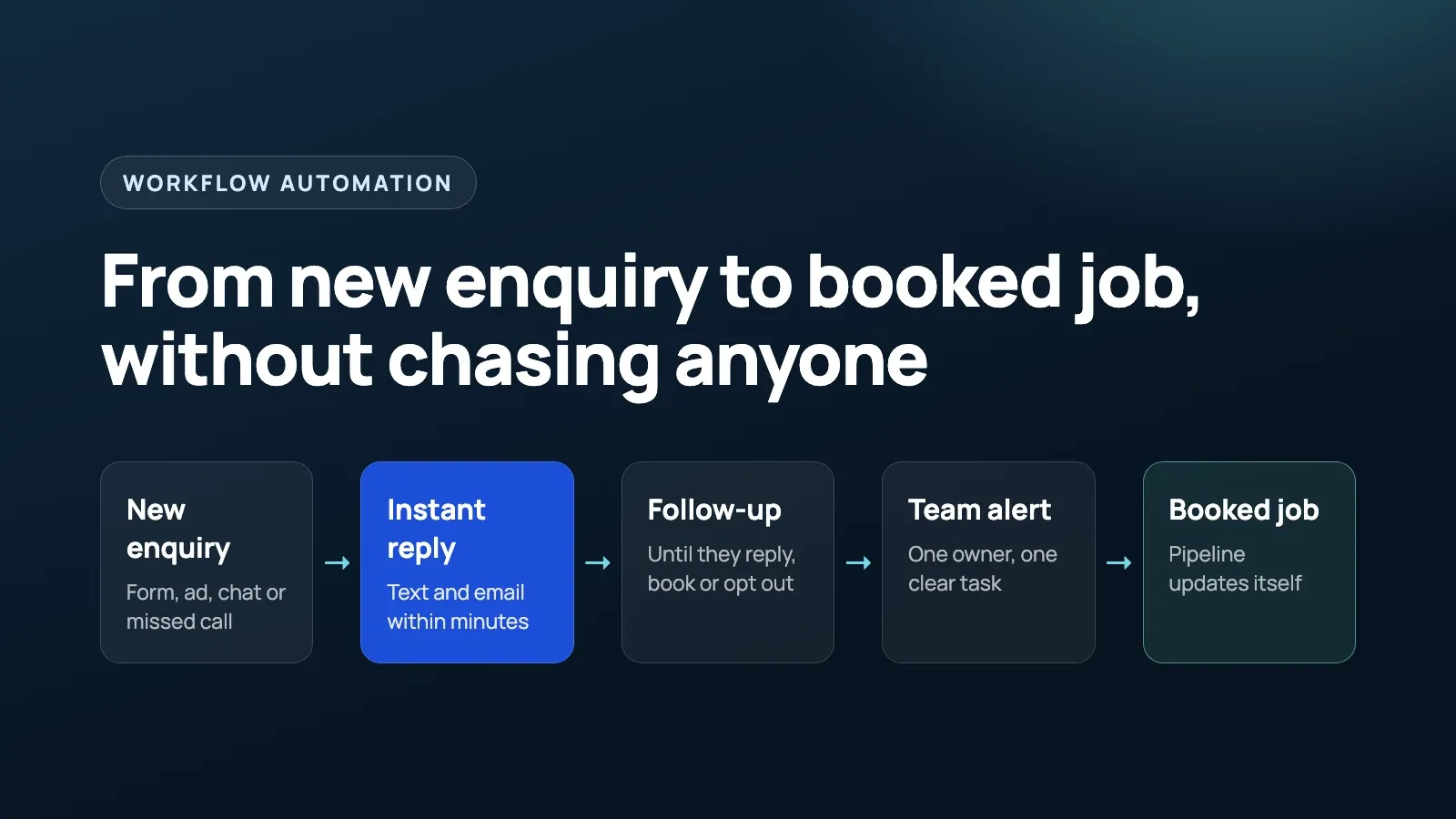
Workflow Automation
What to Text When a Customer Goes Quiet After a Quote (With Example Messages)
A simple quote follow-up sequence from day 0 to day 14, with example texts you can copy and adapt, what to agree before the quote goes out, and when to stop.


On this page
The short answer
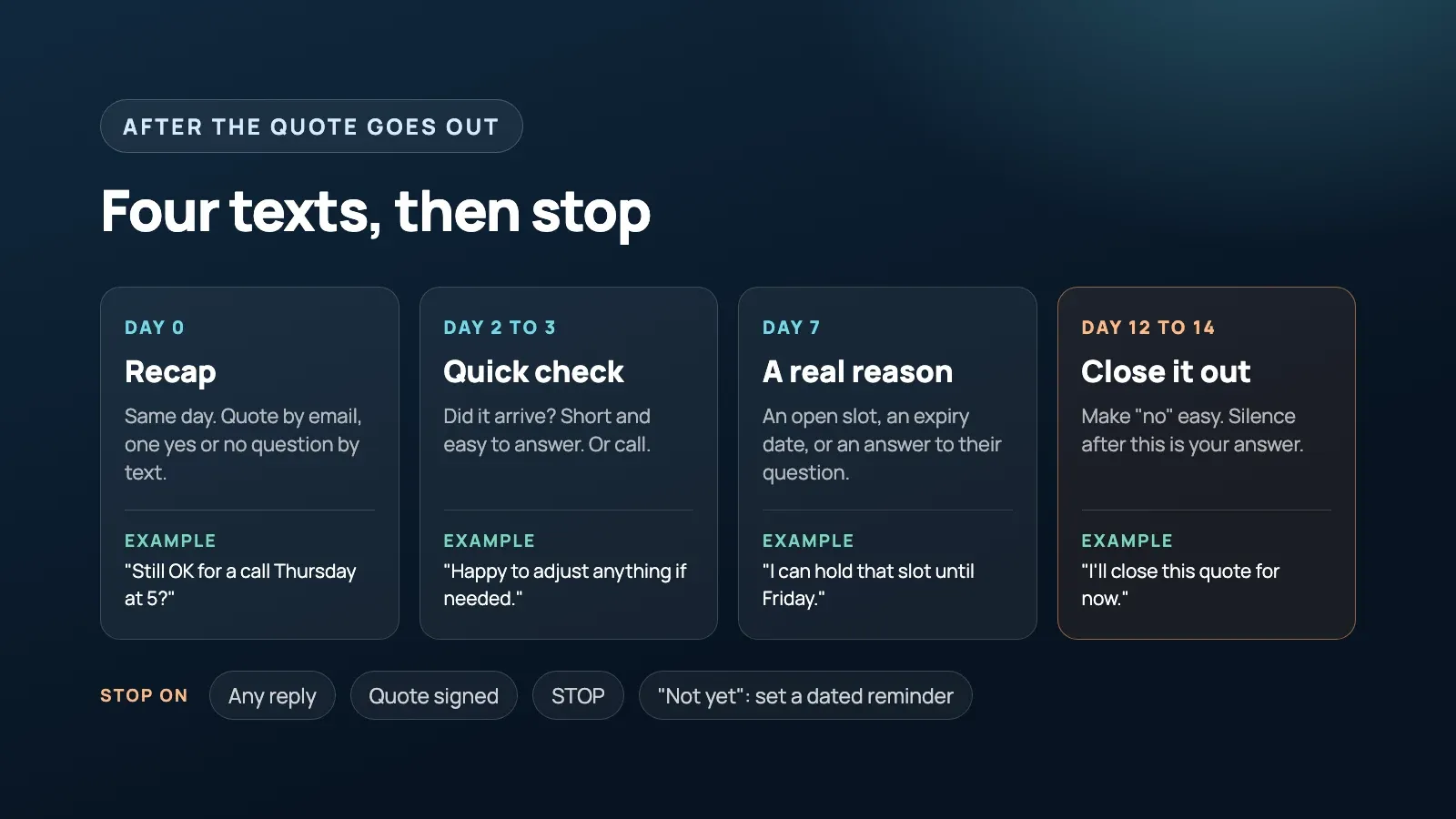
When a customer goes quiet after a quote, text a short recap the same day with one yes or no question, a quick check-in on day 2 or 3, one message with a real reason to reply around day 7, and a last message around day 14 saying you’ll close the quote for now. Keep every text short enough to answer in a few seconds. Most of the work happens before the quote goes out, though: agree a date to talk it through, check the budget, and find out who else has to say yes.
Why do customers go quiet after a quote?
They may be busy, waiting for approval, or comparing prices. Your quote can matter a lot more to you than it does to them. A week goes by, then two, and by then replying feels awkward, especially if they’ve already picked someone cheaper. A short text that makes “we went another way” easy to send does them a favour as well as you.
Some people were only ever collecting prices, and no wording will bring them back. The fix for that group sits earlier, in the questions you ask before you quote.
The third reason is on your side of the counter. In most small businesses, nothing brings a sent quote back up. It sits in the sent folder, the next job takes over, and nobody notices it went unanswered until the customer has booked someone else. A follow-up sequence fixes that by putting the quote back in front of you on a set day.
What should you sort out before the quote goes out?
Agree when you’ll talk next, and check whether the job is real. I’d put more effort here than into the wording of any text, because a follow-up the customer agreed to is easier to send and easier to answer.
Agree the next date before you leave
Before you leave the site or hang up, book the next conversation. Something as plain as “I’ll send the quote tomorrow. Can I call you Thursday evening to go through it?” is enough. Once they’ve said yes to Thursday, calling on Thursday is doing what you both agreed, and nobody feels chased.
If someone won’t commit to any day at all, that tells you how warm the lead really is.
Ask about budget and who decides
A lot of ghosting comes from quoting people who were never going to buy at that price. Ask about budget before you quote. If they won’t give a number, offer three rough options with wide price ranges (the bare minimum, the standard job, and the version they’d love) and firm up whichever one they react to.
Then ask who else has to approve it. That might be a partner, a landlord, a building committee, or a facilities manager whose current contract runs to March. If the person you spoke to doesn’t sign off, silence often means the decision hasn’t come round yet.
If you need something from the customer before you can quote properly, chase that first. For Only Wood Floors, a flooring business in California, we built a text follow-up that asks each new lead for project photos, keeps following up until the photos arrive, and then alerts the team. It runs on native HighLevel workflows. At the time HighLevel had no built-in trigger for incoming picture messages, so we built a workaround for that part.
Put an expiry date on the quote
A quote with a valid-until date gives your day 7 text something real to say. The date can apply to the price (good for 30 days, after which you recheck material costs) or to the start slot (the week of the 14th is yours if you confirm by Friday). Print it on the quote.
Only use dates that are true. If your prices don’t move, don’t pretend they do. Use your schedule instead, because a free start date is a real reason to decide.
What should you text after sending a quote?
Four texts over about two weeks covers most jobs: a recap, a light check, a reason to reply, and a close-out. Shift the days to suit your trade.
| When | What it does | Channel |
|---|---|---|
| Day 0, same day as the quote | Recap with one yes or no question | Text, with the quote by email |
| Day 2 or 3 | Short check that it arrived | Text, or a call if the first text got no answer |
| Day 7 | One real reason to reply: a slot, an expiry date, an answer to their question | Text |
| Day 12 to 14 | Close the quote for now and make “no” easy | Text |
| Later | Only if they gave you a date or a trigger | A reminder for you, not another sequence |
Below is the template I’d start from. The messages are examples, so change the wording until it sounds like you and put in your real details.
Day 0, example:
Hi Megan, it’s Dan from [Business Name]. Just emailed your quote for the deck, with the composite boards we talked about. Still OK for a quick call Thursday at 5 to go through it?
End with a question they can answer in one word. People often stay quiet because a proper reply feels like homework, and “yes” or “make it Friday” takes two seconds.
Day 2 or 3, example:
Hi Megan, did the deck quote come through OK? Happy to change anything that doesn’t look right.
If the day 0 text got nothing back, ring instead. Some people ignore texts from unknown numbers and others never pick up calls, so switching channels reaches people the first one missed.
Day 7, example:
Hi Megan, we’ve had a slot open up the week of the 14th. If you want it for the deck, I can hold it until Friday.
Or, if your quote has an expiry date:
Hi Megan, quick heads up that the price on your deck quote is good until the 30th. After that I’d need to recheck material costs.
Only send the version that’s true. If you have no slot and no deadline, answer a question they asked during the visit, or send a photo of a similar deck you finished recently.
Day 12 to 14, last message, example:
Hi Megan, I haven’t heard back, so I’ll assume the timing isn’t right and close this quote for now. If anything changes, just reply here and I’ll send updated pricing.
I like this message because it leaves room for an honest answer. A reply such as “we’ve pushed it to next year” or “we went with someone else” tells you what to do next. Those are example replies, not results I’m claiming for this template.
Should follow-up texts be short or personal?
Both: short in length, specific in content. A long message explaining your price, or asking whether they’ve had a chance to review everything, reads as if you badly need the job. Two lines that mention their deck read as someone who keeps on top of their work.
Personal means their name and the job, not a paragraph. Leave out apologies, and anything that makes them feel guilty for being busy.
| Instead of | Try |
|---|---|
| “Just checking in to see if you’ve had a chance to look at the quote?” | “Did the deck quote come through OK?” |
| “I haven’t heard back from you yet.” | “Is the deck still on the list for this spring?” |
| A paragraph explaining why your price is fair | “Happy to walk you through the price on a quick call if that helps.” |
| “Why haven’t you replied?” | “No worries if the timing’s changed, just let me know either way.” |
How many times should you follow up on a quote?
Three or four texts over about two weeks is my default, but this is where owners disagree most. It came up in a Reddit discussion among small business owners about customers who ghost after a quote, and the split was clear. Some long-established owners send one or two follow-ups and move on because they don’t want to nag. Others say they often win jobs on the fifth follow-up or later, because by then everyone else has stopped.
Both camps are right for their own businesses. If referrals fill your calendar, chasing cold quotes in the evening is a poor use of your time. If you pay for every lead, a fifth text costs almost nothing next to what that enquiry cost you.
| Your situation | What I’d do |
|---|---|
| Small job, plenty of work on | Day 0 recap and one check-in, then stop |
| Typical job, steady workload | The four-text sequence above |
| Large job, or a lead you paid for | The four texts plus a phone call around day 2 or 3 |
| Customer named a later date or event | Skip the sequence and set a reminder for that date |
Whatever you choose, decide it in advance. Then you aren’t working out how pushy to be every time a quote goes quiet.
What do you do with a “not yet”?
Write down the date or event they’re waiting for, and come back then. A “not yet” usually has a reason attached, like a budget that resets in January, a bonus that lands in March, or a lease that ends in June. At the first conversation, ask what would need to change for them to go ahead. Your follow-up then lands when that thing happens, rather than on a random 30-day timer.
You don’t need a big CRM for this. A spreadsheet with four columns (customer, next action, date, and why they didn’t buy yet) covers it for a small crew. Sort it by date every morning.
How do you automate quote follow-up without sounding like a bot?
Automate the timing and keep the wording yours. I build these automations for a living, so weigh my view with that in mind, but the setup looks much the same in most CRMs:
- Moving a job to a “Quote sent” stage starts the sequence and records the sent date and the expiry date.
- A person writes or checks the day 0 recap, because it should mention the actual job.
- The day 3, day 7 and day 14 texts go out from templates written in your own words, during daytime hours only.
- Any reply stops the sequence and gives the job owner a task to answer it. A signed quote moves the job forward, and STOP means no more messages.
- The day 14 close-out moves the job to “Closed, no response”, or to a dated reminder if they said “not yet”.
The stage before this, replying fast to new enquiries and the texting registration rules that come with it, is covered in our guide to automated lead follow-up.
One rule I wouldn’t bend: an automated message should never promise a new price, a discount or a start date until a person has confirmed it.
FAQ
How long should you wait to follow up on a quote?
Send a short recap the same day the quote goes out, then a first check-in two or three days later. After that I’d space messages about a week apart and stop around day 14, unless the customer gave you a later date to come back.
What do you text a customer who ghosted after a quote?
Something short that is easy to answer, such as asking whether the quote came through and offering to change anything. If they stay quiet, send one message with a real reason to reply, then a last message saying you will close the quote for now unless they want to go ahead.
How many times should you follow up on a quote?
Three or four texts over about two weeks suits most jobs. For a small repair, one or two is plenty. For a large job, or a lead you paid for, add a phone call and keep going a little longer. Decide the number before the quote goes out.
Should a quote have an expiry date?
It helps. A date when the price or the start slot runs out gives your follow-up a real reason to exist and gives the customer a deadline to decide. Only use dates and price changes that are true.
Is it pushy to follow up on a quote?
Not if the customer agreed to it. Ask before you leave or hang up when you can check in, then follow up on that day. Short messages that make it easy to say no come across as organised, and most people take them that way.
Final thought
If I could change one habit, it would be booking the next conversation before the quote goes out. With that date in place, the texts afterwards can be short and a bit boring, and you’ll know in advance when you’re going to stop. I’d fix the missing date and reminder before polishing the wording.
If you want help setting up quote follow-up inside the CRM you already use, with your own wording and proper stop rules, see how we approach workflow automation.
Free 30-minute strategy call
Want this working in your business?
Show us where time, leads, or money are leaking. We will map the simplest system that fixes it. If we are not a fit, you still leave with a clearer plan.
Book a Free Strategy Call